Your dog ate something suspicious at 10pm on a Sunday. The vet clinic is closed. The emergency hospital is forty minutes away and you're not sure if this is an emergency or just your dog being a dog. That moment of panic. That's the problem PawSquad was built to solve.
We were brought on to build and scale the mobile app behind PawSquad, a veterinary telemedicine platform that connects pet owners with qualified vets via video, voice, and chat. What started as a UK-based pet advice service has grown into a platform serving over 350,000 pet owners, backed by more than 120 veterinary professionals.
And we built the app that makes it all work.
01What the app actually does
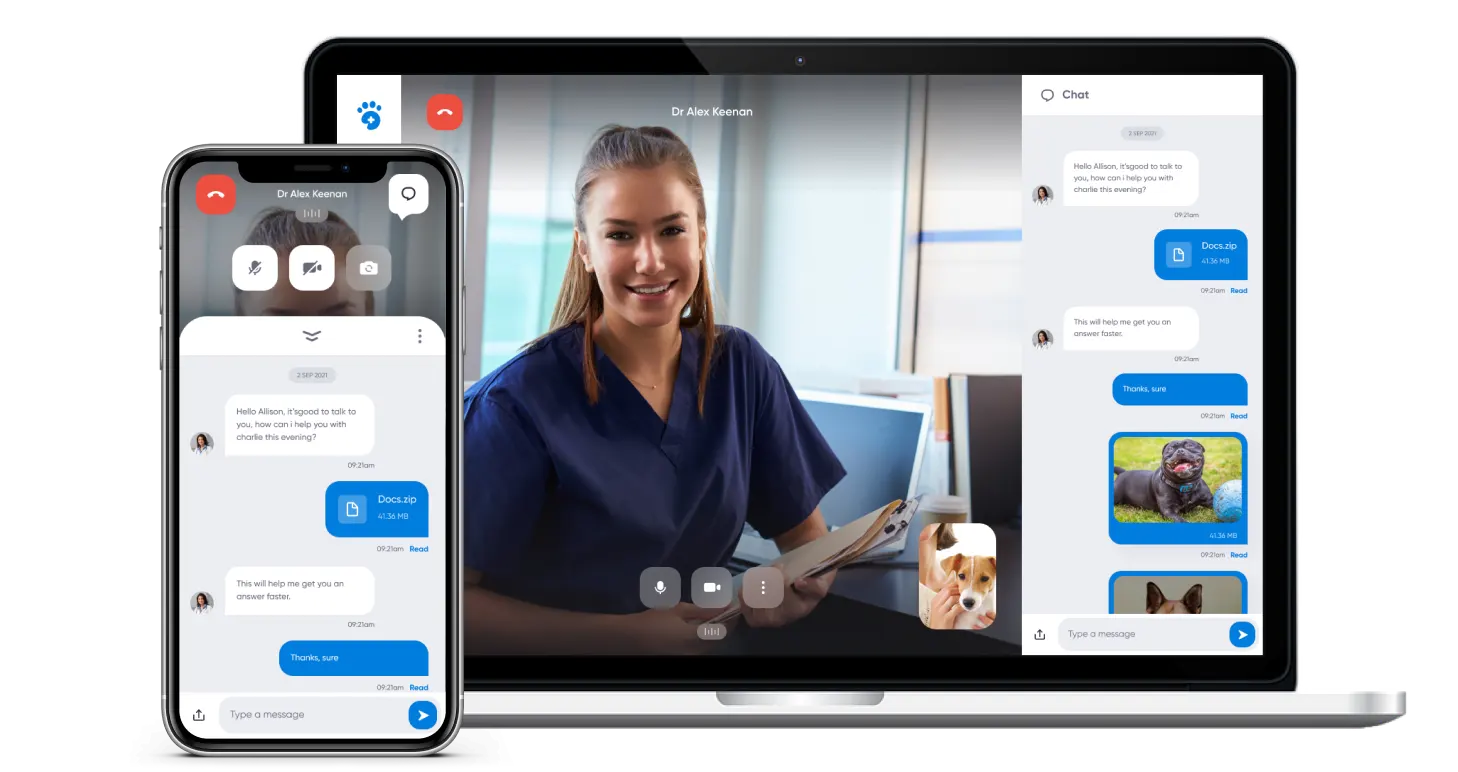
PawSquad isn't a chatbot with pre-written answers. It's a full telemedicine experience. A pet owner opens the app, describes the issue, and joins a virtual waiting room. Within seconds, they're connected to a qualified vet who can assess the situation through live video, voice call, or text chat.
Live video calls
Real-time video consultations with qualified vets, with failover for poor network conditions.
Chat messaging
Persistent text chat with photo sharing, running alongside or instead of video.
Queue management
Smart routing that matches pet owners with available vets and manages wait times at peak hours.
Payments & memberships
Subscriptions, one-off payments, and promotional pricing for members and pay-as-you-go consultations.
Behind the scenes, the platform manages payment processing, call quality monitoring, queue optimisation, and real-time notifications. That's the kind of infrastructure that keeps 350,000 users from ever seeing a loading spinner when they need a vet.
02Behind the video calls
Real-time video with a veterinary professional isn't the same as a Zoom call with a colleague. When someone is worried about their pet, dropped calls aren't minor annoyances. They're trust-breaking moments.
We built a reliable call routing system that manages queues, matches pet owners with available vets, handles call handoffs, and tracks metadata for every consultation. The platform monitors call quality in real time and has failover mechanisms for poor network conditions.
At peak hours, consultation failure rates stay below 3%. That number matters because every failed call is a pet owner who needed help and didn't get it.
Every failed call is a pet owner who needed help and didn't get it.
The real-time layer extends beyond video. Chat messaging, push notifications, and queue status updates all flow through a persistent connection layer that keeps every part of the experience responsive, even on spotty mobile networks.
03What most people don't see
The features that matter most in a platform like this are the ones users never think about. The questionnaire system that helps vets triage before a call starts. The deep linking that lets a vet share a specific advice article after a consultation. The membership and payment infrastructure that handles subscriptions, one-off payments, and promotional pricing for members and pay-as-you-go consultations.
The localisation framework we put in place supports multiple languages, not because the current market demanded it, but because the platform was designed to expand. When PawSquad enters a new market, the translation layer is already waiting.
04What we'd tell another founder
If you're building a marketplace app, connecting experts with consumers in real time, the hard part isn't the video call. Video is a solved problem with good SDKs. The hard part is everything around it: the queue that decides who talks to whom, the payment system that handles different pricing models, the notification system that gets the timing right, and the mobile experience that makes it all feel effortless on a phone screen.
PawSquad works because the engineering behind it respects the urgency of the moment. When your pet is unwell, you don't have patience for loading screens, confusing flows, or dropped connections. Every technical decision we made was in service of that single insight.