Students don't want to read textbooks. Not because they're lazy, but because they grew up watching more than reading. A generation raised on YouTube and streaming learns differently. The question isn't whether to adapt to that. It's how to do it without dumbing things down.
Torah Live had already figured out the content. High-quality educational videos that bring Jewish learning to life through cinematic production, engaging storytelling, and real-world relevance. What they needed was an app that delivered that content the way modern students expect: instantly, beautifully, and on their terms.
01What we built
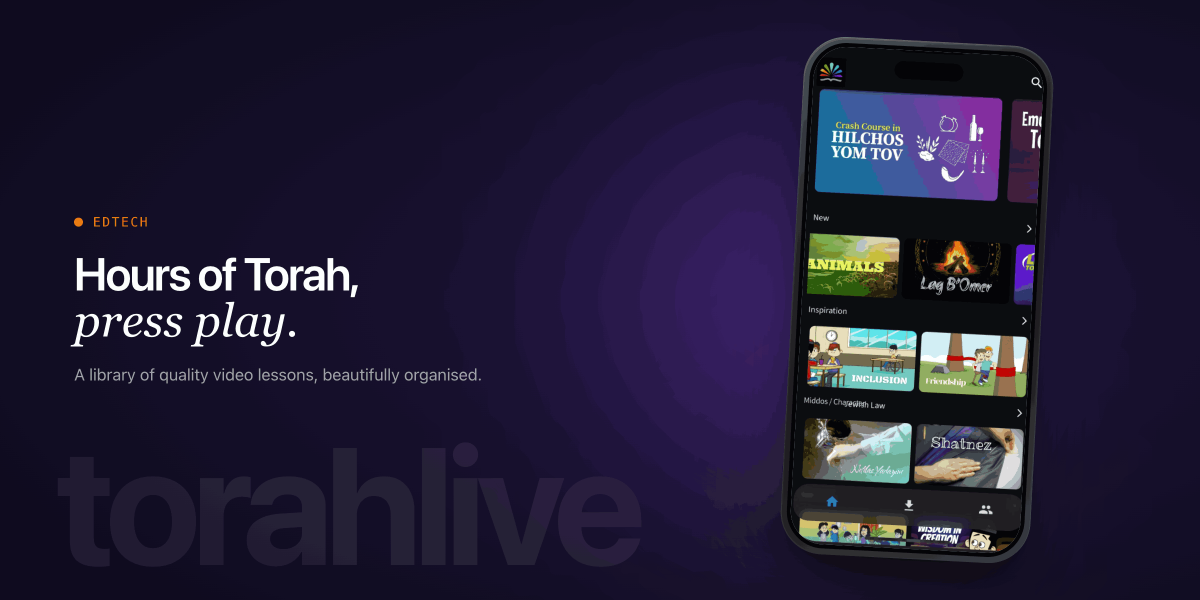
The app is a video learning platform with the experience of a streaming service. Categories and courses organised by topic. Playlists that guide students through related lessons in sequence. A video player built for learning rather than passive watching. Search that surfaces the right lesson from a growing library. And a download system that makes offline learning simple.
Offline video
Download lessons for viewing anywhere, because learning shouldn't depend on bandwidth.
Playlists
Curated lesson sequences that guide students through topics in the right order.
Review system
Student ratings and comments that create a feedback loop for content improvement.
Progress tracking
Visual progress through courses and categories, motivating continued learning.
It works like a streaming service built for learning: every piece of content is deliberate, and the platform is designed to keep students engaged lesson after lesson.
02Download and learn anywhere
Not every student has reliable internet. Some study on buses. Some live in areas with patchy connectivity. Some simply want to save data.
The app lets students download lessons for offline viewing. The download manager handles interruptions, resumes partial downloads, and keeps storage usage transparent. Downloaded content is organised the same way as online content, so the experience doesn't degrade when the internet disappears.
For an educational app, offline access isn't a premium feature. It's equity. A student's ability to learn shouldn't depend on their bandwidth.
03The review system
Students leave reviews on individual lessons. This creates a feedback loop that's valuable for everyone. Content creators see which lessons resonate and which need rework. New students use reviews to find the best starting points. And the community element, seeing that other students found a lesson helpful, adds social proof that drives engagement.
Reviews are simple: a rating and optional comment. No complex forms, no barriers. The easier it is to leave feedback, the more feedback you get, and the better the content becomes.
04Built to grow
Educational content libraries don't stay static. New courses are added. New categories emerge. New formats appear. The app was built with a modular architecture that makes adding new content types straightforward.
The navigation adapts to the content structure: a library with ten courses looks and feels different from one with a hundred, but the same underlying system handles both. Categories can be nested, playlists can be reordered, and the home screen prioritises fresh content without burying the classics.
Learning sticks when it feels like something you chose, not something assigned.05
Why this approach works
The best educational apps don't try to replicate a classroom. They recognise that a phone is a different medium with different strengths. Short, focused lessons work better than hour-long lectures. Visual navigation works better than text-heavy menus. The ability to bookmark, download, and revisit content works better than a rigid schedule.
Torah Live's app works because it respects how students actually learn in 2026: on their own time, at their own pace, on a screen they chose.