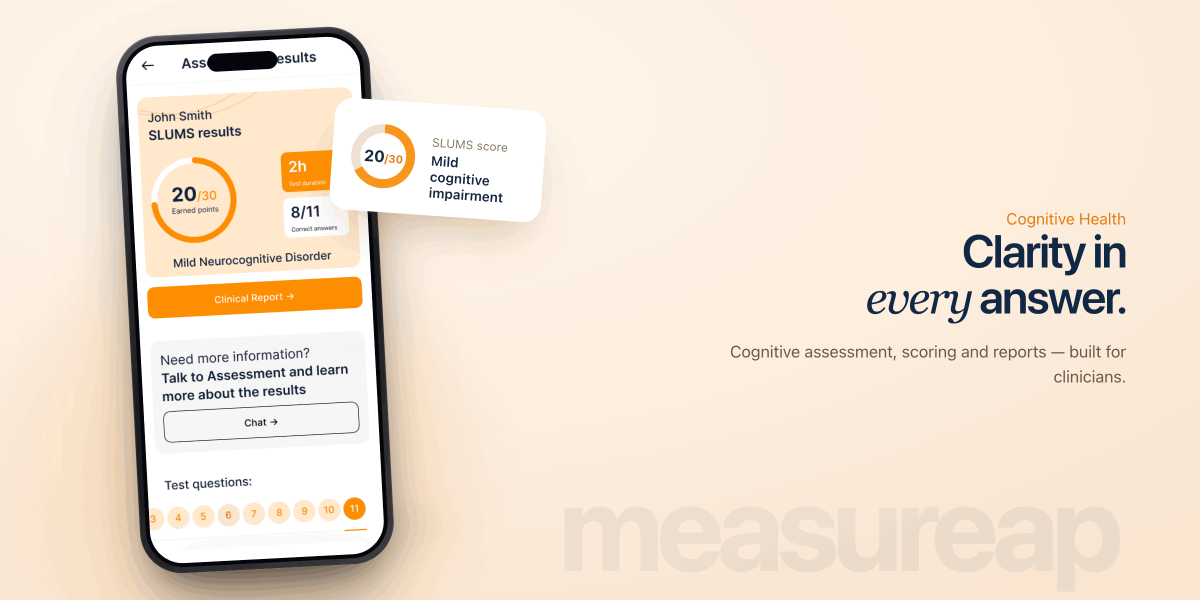
Clinicians spend hours running cognitive assessments with pen and paper. A patient reads a short story, answers questions, recalls words from a list shown ten minutes ago. The clinician scores it by hand, files the results, and moves on. Those results are rarely compared over time. Patterns that could signal early cognitive decline get buried in folders.
We built an app that changes that.
01What it does
MeasureAP is a mobile platform where healthcare professionals run structured cognitive assessments with patients, and get scored results straight away.
Text questions
Structured questions across clinical domains, scored automatically as the patient responds.
Visual recognition
Image-based tasks that test pattern recognition and visual processing ability.
Story comprehension
Patients read a passage and answer questions that test understanding and retention.
Memory recall
Items shown early in the session are tested later, measuring short-term and working memory.
Each assessment is structured around clinical domains, categories that clinicians can define and customise based on what they're measuring. The app scores responses automatically, tracks results over time, and flags patients who may need closer attention.
02A conversation, not a clipboard
One of the most important design decisions was how assessments feel to the patient. Traditional cognitive tests can be intimidating. A clinician with a clipboard, a ticking clock, a formal questionnaire. It all adds stress that can skew results.
We built a chat-based assessment interface. Instead of filling out forms, patients interact through a conversational flow that guides them through questions naturally. The screen shows one thing at a time. A story to read. A set of images to identify. A memory prompt that surfaces ten minutes after the original was shown.
To the patient it feels less like a test. The clinician still gets the same rigorous data.03
The admin layer
Behind the mobile app sits a web-based admin dashboard where clinicians manage everything. Patient profiles with medical history. Assessment configurations with custom question sets. Historical results displayed as trends, making it easy to spot whether a patient's scores are stable, improving, or declining.
The admin panel was built as a separate React application, connected to the same Firebase backend. Clinicians can create new assessments, adjust scoring thresholds, and review results without touching the mobile app.
All patient data stays secure, with role-based access ensuring that clinicians only see their own patients.
04Why this matters
Early detection of cognitive decline depends on consistent, repeatable testing. Paper-based assessments introduce variability: different clinicians administer them differently, scoring can be subjective, and comparing results across visits means manually digging through files.
Digital assessments remove that variability. Every test is administered the same way, scored the same way, and stored in the same system. When a clinician opens a patient's profile, they see a clear timeline of cognitive performance, not a stack of paper.
The memory recall feature is particularly valuable. The app shows a set of items early in the assessment, then prompts the patient to recall them later. This tests short-term and working memory in a way that's difficult to standardise on paper, but straightforward in an app that controls timing and sequence.
05The full picture
MeasureAP is a three-part system: a mobile app for running assessments, a web dashboard for managing patients and reviewing results, and a cloud backend that ties everything together. Each part was built to do one job well. The mobile app is focused and distraction-free for patients, the admin panel is dense and information-rich for clinicians, and the backend handles scoring, storage, and access control quietly in the background.